
Noppadol Panchan
Department of Process and Industrial Engineering, School of Engineering and Industrial Technology, Mahanakorn University of Technology, Bangkok 10530, Thailand
Keywords: Carbon sequestration Climate mitigation Microbial communities Rock weathering
Abstract
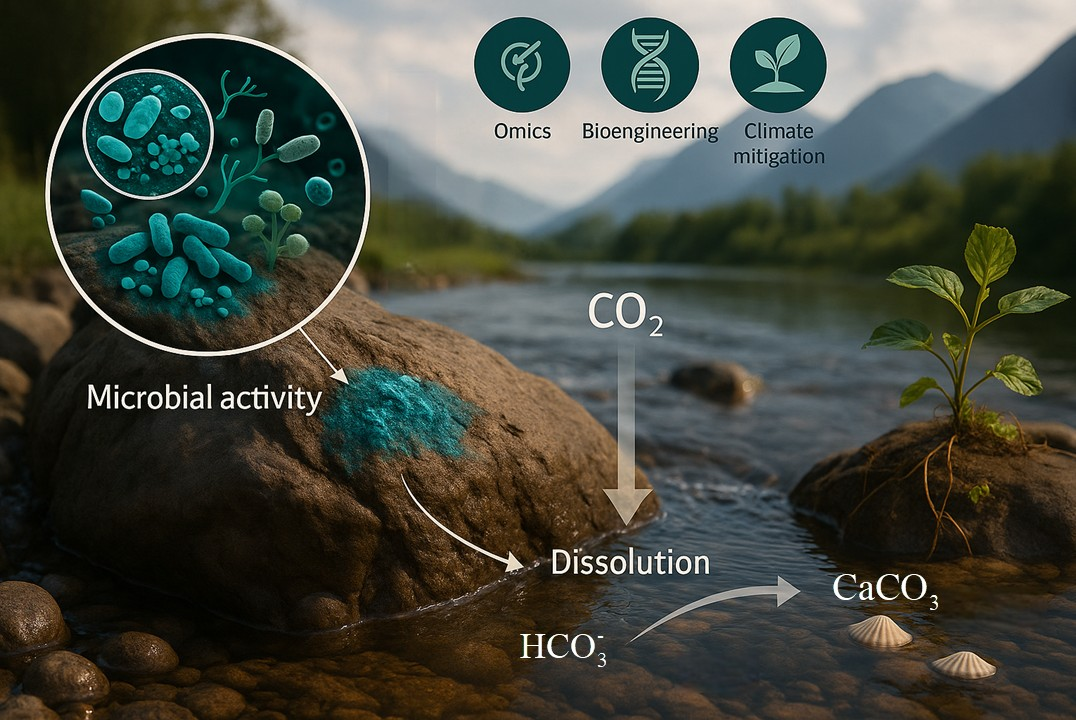
Enhanced rock weathering has emerged as a promising strategy to accelerate carbon dioxide (CO2) removal by promoting the dissolution of silicate minerals and the subsequent carbonation reactions. This review synthesizes the current knowledge on microbial contributions to enhanced rock weathering as a climate mitigation strategy. Microorganisms play pivotal roles in facilitating rock weathering processes through diverse physical, chemical, and biological mechanisms. Recent advancements in microbial ecology reveal insights into the diversity and functionality of microbial communities across different environments and substrates. Bioengineering approaches offer opportunities to optimize microbial activities and metabolic pathways, thereby increasing mineral dissolution rates. Future research directions include integrating omics approaches, advancing experimental techniques, and developing sustainable strategies for large-scale implementation. Harnessing the potential of microbially-driven rock weathering presents promising avenues for mitigating climate change and promoting sustainable development.
How to Cite
Panchan, N. (2026). Exploring bioengineering strategies to enhance microbial-driven rock weathering for climate mitigation. Asia-Pacific Journal of Science and Technology, 31(01), APST–31. https://doi.org/10.14456/apst.2026.11
References
Rigopoulos I, Harrison AL, Delimitis A, Ioannou I, Efstahiou AM, Kyratsi T. Carbon sequestration via enhanced weathering of peridotite and basalts in seawater. Appl Geochem. 2018;91:197-207.
Ingalls M, Blättler CL, Higgins JA, Magyar JS, Eiler JM, Fischer WW. P/Ca in carbonates as a proxy for alkalinity and phosphate levels. Geophys Res Lett. 2020;47:1-11.
Renforth P, Washbourne CL, Taylder J, Manning DAC. Silicate production and availability for mineral carbonation. Environ Sci Technol. 2011;45:2035-2041.
Kelemen PB, McQueen N, Wilcox J, Renforth P, Dipple G, Vankeuren AP. Engineered carbon mineralization in ultramafic rocks for CO2 removal from air: Review and new insights. Chem Geol. 2020;550:119628-119649.
Knapp WJ, Tipper ET. The efficacy of enhancing carbonate weathering for carbon dioxide sequestration. Front Clim. 2022;4: 928215-928235.
Larkin CS, Andrews MG, Pearce CR, Yeong KL, Beerling DJ, Bellamy J. Quantification of CO2 removal in a large-scale enhanced weathering field trial on an oil palm plantation in Sabah, Malaysia. Front Clim. 2022;4:959229-959248.
Zondervan JR, Hilton RG, Dellinger M, Clubb FJ, Roylands T, Ogrič M. Rock organic carbon oxidation CO2 release offsets silicate weathering sink. Nat. 2023;623:329–333.
Wild B, Gerrits R, Bonneville S. The contribution of living organisms to rock weathering in the critical zone. Mater Degrad. 2020;6(98):1-16.
Bin L, Ye C, Lijun Z, Ruidong Y. Effect of microbial weathering on carbonate rocks. Earth Sci Front. 2008;15(6):90-99.
Liu D, Lian B, Dong H. Isolation of Paenibacillus sp. and assessment of its potential for enhancing mineral weathering. Geomicrobiol J. 2012;29:413-421.
Yang H, Lu L, Chen Y, Ye J. Transcriptomic analysis reveals the response of the bacterium Priestia Aryabhattai SK1-7 interaction and dissolution with potassium feldspar. Appl Environ Microbiol. 2023; 89(5):1-16.
Berner RA. A new look at the long-term carbon cycle. GSA Today. 1999;9(11):1-6.
Swanson EJ. 7th ed. Catalytic enhancement of silicate mineral weathering for direct carbon capture and storage. New York: Columbia University; 2014.
Penman DE, Rugenstein JKC, Ibarra DE, Winnick MJ. Silicate weathering as a feedback and forcing in Earth’s climate and carbon cycle. Earth Sci Rev. 2020;209:103298-103303.
Dahl TW, Arens SKM. The impacts of land plant evolution on earth’s climate and oxygenation state -an interdisciplinary review. Chem Geol. 2020;547:119665-119689.
Almaraz M, Bingham NL, Holzer IO, Geoghegan EK, Goertzen H, Sohng J. Methods for determining the CO2 removal capacity of enhanced weathering in agronomic settings. Front Clim. 2022;4:970429-970446.
Edwards DP, Lim F, James RH, Pearce CR, Scholes J, Freckleton RP, Beerling DJ. Climate change mitigation: potential benefits and pitfalls of enhanced rock weathering in tropical agriculture. Biol Lett. 2017;13:20160715-20160721.
Dessert C, Dupre B, Gaillardet J, Francois LM, Allegre CJ. Basalt weathering laws and the impact of basalt weathering on the global carbon cycle. Chem Geol. 2023;202: 257–273.
Taylor LL, Leake JR, Quirk J, Hardy K, Banwart SA, Beerling DJ. Biological weathering and the long-term carbon cycle: integrating mycorrhizal evolution and function into the current paradigm. Geobiol. 2009;7:171–191.
Oeser RA, Blanckenburg F. Do degree and rate of silicate weathering depend on plant productivity. Biogeosci. 2020;17:4883-4917.
Ribeiro IDA, Volpiano CG, Vargas LK, Granada CE, Lisboa BB, Passaglia LMP. Use of mineral weathering bacteria to enhance nutrient availability in crops: A review. Front Plant Sci. 2020;11:590774-590793.
Zhao M, Wang M, Zhao Y, Hu N, Qin L, Ren Z, Wang G, Jiang M. Soil microbial abundance was more affected by soil depth than the altitude in peatlands. Front Microbiol. 2022;13:1068540-1068549.
Teng W, Kuang J, Luo Z, Shu W. Microbial diversity and community assembly across environmental gradients in acid mine drainage. Minerals. 2017;7:106-115.
Pattanaik A, Sukla LB, Pradhan D, Samal DPK. Microbial mechanism of metal sulfide dissolution. Mater. Today Proc. 2020;30(2):326-331.
Castro IM, Fietto JLR, Vieira RX, Trópia MJM, Campos LMM, Paniago EB. Bioleaching of zinc and nickel from silicates using Aspergillus niger cultures. Hydrometallurgy. 2000;57:39-49.
Robles-Fernández A, Areias C, Daffonchio D, Vahrenkamp VC, Sánchez-Román M. The role of microorganisms in the nucleation of carbonates, environmental implications and applications. Minerals. 2022;12:1562-1598.
Zhu T, Dittrich M. Carbonate precipitation through microbial activities in natural environment, and their potential in biotechnology: A review. Front Bioeng Biotechnol. 2016;4(4):1-21.
Jung P, Baumann K, Emrich D, Springer A, Felde VJMNL, Dultz S, et al. Lichens bite the dust – A bioweathering scenario in the Atacama desert. J Sci. 2020;23(11):101647-101675.
Genderjahn S, Lewin S, Horn F, Schleicher AM, Mangelsdorf K, Wagner D. Living lithic and sublithic bacterial communities in namibian drylands. Microorganisms. 2021;9:235-254.
Chen J, Li F, Zhao X, Wang Y, Zhang L, Yan L. Change in composition and potential functional genes of microbial communities on carbonatite rinds with different weathering times. Front Microbiol. 2022;13:1024672-1024686.
Sanyal A, Antony R, Ganesan P, Thamban M. Metabolic activity and bioweathering properties of yeasts isolated from different supraglacial environments of Antarctica and Himalaya. Anton. Leeuw. Int J G. 2020;113(12):2243–2258.
Potysz A, Bartz W. Bioweathering of minerals and dissolution assessment by experimental simulations-Implications for sandstone rocks: A review. Constr Build Mater. 2022;316:125862-125876.
Cheng C, Wang Q, He L, Sheng X. Change in mineral weathering behaviors of a bacterium Chitinophaga jiangningenesis JN53 under different nutrition conditions, J Basic Microbiol. 2017;57: 293-301.
Daunoras J, Kačergius A, Gudiukaite R. Role of soil microbiota enzymes in soil health and activity changes depending on climate change and the type of soil ecosystem. Biology. 2024;13:85-123.
Verbruggen E, Struyf E, Vicca S. Can arbuscular mycorrhizal fungi speed up carbon sequestration by enhanced weathering. Plants People Planet. 2020;10:1-9.
Etesami H, Jeong BR, Glick BR. Contribution of Arbuscular Mycorrhizal fungi, phosphate–solubilizing bacteria, and silicon to uptake by plant. Front Plant Sci. 2021;12:699618-699646.
Liu H, Liu X, Li X, Fu Z, Lian B. The molecular regulatory mechanisms of the bacteria involved in serpentine weathering coupled with carbonation. Chem Geol. 2021;565:120069-120079.
Lemare M, Puja H, David SR, Mathieu S, Ihiawakrim D, Geoffroy VA, Rigouin C. Engineering siderophore production in Pseudomonas to improve asbestos weathering. Microb Biotechnol. 2022; 15(9):2351-2363.
Liu C, Mou L, Yi J, Wang J, Liu A, Yu J. The eno gene of Burkholderia cenocepacia strain 71- 2 is involved in phosphate solubilization. Curr Microbiol. 2019;76(4):495–502.
Wang Q, Zhang Z, Zhu Y, He L, Sheng X. Impact of poxB, pta, and ackA genes on mineral-weathering of Enterobacter cloacae S71. J. Basic Microbiol. 2018;58(7):633-642.
Wang YL, Sun LJ, Xian CM, Kou FL, Zhu Y, He LY. Interactions between biotite and the mineral-weathering bacterium Pseudomonas azotoformans F77. Appl Environ Microbiol. 2020;86(7): 1–17.
Wang YL, Dong W, Xiang KX, Wang Q, He LY, Sheng XF. A combination of genomics, transcriptomics, and genetics provides insights into the mineral weathering phenotype of Pseudomonas azotoformans F77. Appl Environ Microbiol. 2021;87(24):1-18.
Kirtzel J, Ueberschaar N, Deckert-Gaudig T, Krause K, Deckert V, Gadd GM. Organic acids, siderophores, enzymes and mechanical pressure for black slate bioweathering with the basidiomycete Schizophyllum commune. Environ Microbiol. 2019;22(4):1535-1546.
Sun H, Wang J, Li Y, Yang S, Chen DD, Tu Y. Synthetic biology in microalgae towards fucoxanthin production for pharmacy and nutraceuticals. Biochem Pharmacol. 2024;220:115958-115968.
Garg D, Samota MK, Kontis N, Patel N, Bala S, Rosado AS. Revolutionizing biofuel generation: unleashing the power of CRISPR-Cas mediated gene editing of extremophiles. Microbiol Res. 2023; 274:127443-127460.
Buck HJ, Aines RD. Carbon dioxide removal primer. Environ Sci J. 2021;15(1):1–10.
Grant B. Harnessing carbon mineralization: a powerful tool to combat climate change. Happy Eco News J. 2023;5(2):45–50.
Published: Jan 19, 2026
License

This work is licensed under a Creative Commons Attribution-NonCommercial-NoDerivatives 4.0 International License.