
Jutarut Iewkittiyakorn
Division of Biological Science, Faculty of Science, Prince of Songkla University, Hat Yai, Songkhla 90112, Thailand
Trithep Savisai
Division of Biological Science, Faculty of Science, Prince of Songkla University, Hat Yai, Songkhla 90112, Thailand
Piyaporn Khunthongkaew
Division of Biological Science, Faculty of Science, Prince of Songkla University, Hat Yai, Songkhla 90112, Thailand
Juntima Chungsiriporn
Division of Chemical Engineering, Faculty of Engineering, Prince of Songkla University, Hat Yai, Songkhla 90112, Thailand
Keywords: Agricultural waste Coffee grounds Compost Compost nutrient Food waste Soybean meal
Abstract
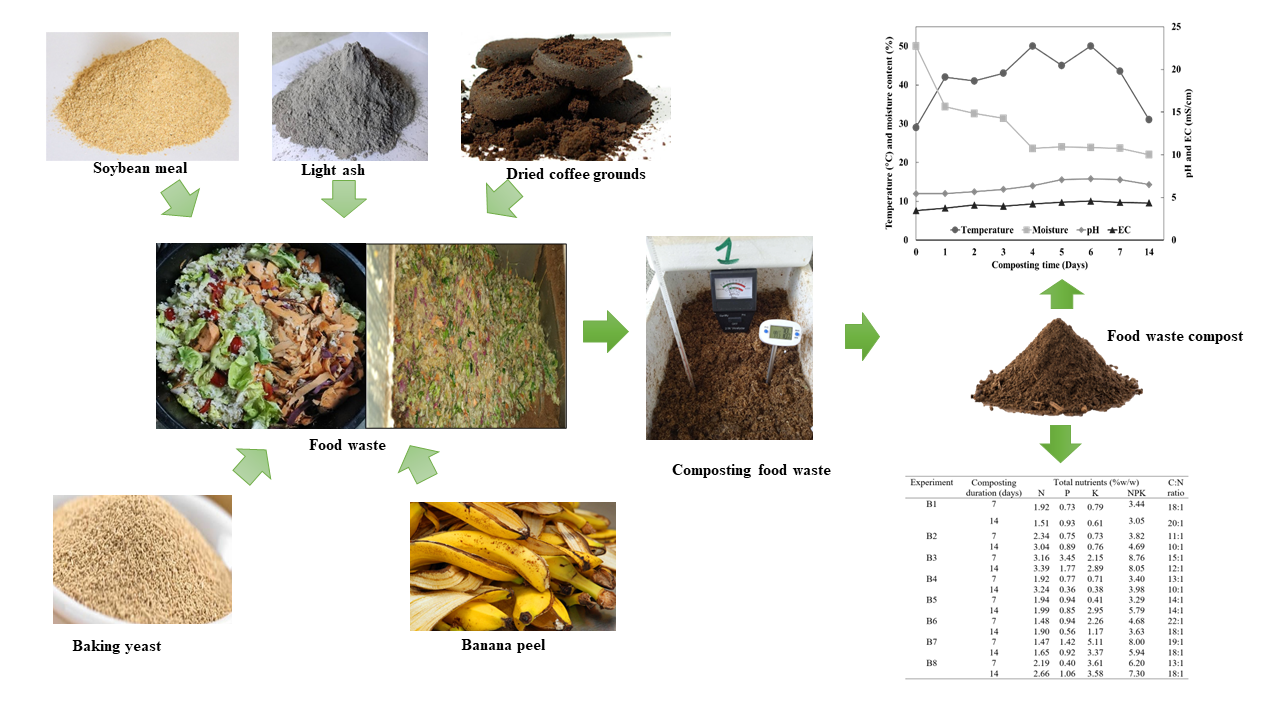
Food waste (FW) management is a critical global challenge due to its environmental and economic impacts. Composting provides a sustainable recycling pathway but FW alone often requires supplementation with carbon-rich residues to balance moisture and enhance compost quality. This study investigated the effects of co-composting FW with dried coffee grounds, soybean meal (SM), banana peel, and light rubber wood ash (LA) in different proportions (0–20% w/w) for 14 days in foam box systems. The objective was to identify the additive and concentration that most effectively improved the nutrient composition of the obtained compost. Results showed that agricultural residues significantly increased macronutrient levels. In particular, 20% SM yielded the compost with the highest nutrient concentrations, with total N, P₂O₅, and K₂O reaching 3.39%, 1.77%, and 2.89% (w/w), respectively, compared with 1.51%, 0.93%, and 0.61% (w/w) in the control. LA enhanced compost alkalinity and K₂O content. These findings demonstrate that SM and LA are promising additives for producing a nutrient-rich compost from FW that could contribute to sustainable waste management and the development of high-quality organic fertilizers.
How to Cite
Iewkittiyakorn, J. ., Savisai, T. ., Khunthongkaew, P. ., & Chungsiriporn, J. . (2026). Nutrient enrichment of food waste compost using agricultural residues. Asia-Pacific Journal of Science and Technology, 31(02), APST–31. https://doi.org/10.22299/apst.2026.280165
References
Gustavsson J, Cederberg C, Sonesson U, van Otterdijk R, Meybeck A. Global food losses and food waste: Extent, causes and prevention. Rome: FAO; 2011.
Pollution Control Department. Thailand state of pollution report 2021. Bangkok: Ministry of Natural Resources and Environment; 2022.
Haug RT. The practical handbook of compost engineering. Boca Raton: CRC Press; 2018.
Epstein E. Industrial composting: Environmental engineering and facilities management. Boca Raton: CRC Press; 2011.
Bernal MP, Alburquerque JA, Moral R. Composting of animal manures and chemical criteria for compost maturity assessment. Bioresour Technol. 2009;100(22):5444–5453.
Weglarz A, Błońska E, Lasota J, Gruba P. Food waste compost as a peat alternative for growing ornamental plants. Agronomy. 2020;10(3):407-409.
Diacono M, Montemurro F. Long-term effects of organic amendments on soil fertility. A review. Agron Sustain Dev. 2010;30:401–422.
Awasthi MK, Pandey AK, Khan J, Bundela PS, Wong JWC, Selvam A. Evaluation of thermophilic fungal consortium for organic municipal solid waste composting. Bioresour Technol. 2014;168:214–221.
El-Naggar A, Lee SS, Rinklebe J, Farooq M, Song H, Sarmah AK, et al. Biochar application to low fertility soils: A review of current status and future prospects. Geoderma. 2018;337:536–554.
Mussatto SI, Machado EM, Martins S, Teixeira JA. Production, composition, and application of coffee and its industrial residues. Food Bioprocess Technol. 2011;4:661–672.
Panusa A, Zuorro A, Lavecchia R, Marrosu G, Petrucci R. Recovery of natural antioxidants from spent coffee grounds. J Agric Food Chem. 2013;61(17):4162–4168.
Campos-Vega R, Loarca-Piña G, Vergara-Castañeda HA, Oomah BD. Spent coffee grounds: A review on current research and future prospects. Trends Food Sci Technol. 2015;45(1):24–36.
Zhang L, Sun X. Addition of soybean meal to food waste composting: Effects on nutritional quality of compost and composting process. Bioresour Technol. 2019;272:82–88.
Oliveira LS, Franca AS, Camargos RR, Ferraz VP. Coffee oil as a potential feedstock for biodiesel production. Bioresour Technol. 2008;99(8):3244–3250.
Emaga TH, Andrianaivo RH, Wathelet B, Tchango JT, Paquot M. Effects of the stage of maturation and varieties on the chemical composition of banana and plantain peels. Food Chem. 2007;103(2):590–600.
Kollert W, Walotek PJ. Situation and outlook of the rubberwood sector. FAO Planted Forests and Trees Working Paper FP/48/E. Rome: FAO; 2015.
Chiemchaisri C, Charnnok B, Visvanathan C. Recovery of plastic wastes from dumpsite as refuse-derived fuel and its utilization in small gasification system. Bioresour Technol. 2010;101(5):1522.
Verma H, Choubisa L, Dubey A. Use of fly ash as a supplement to biofertilizer: A. 2016; J. Phytol. Res. 29(1&2): 85-91.
. Jala S, Goyal D. Fly ash as a soil ameliorant for improving crop production—a review. Bioresour Technol. 2006;97(9):1136–1147.
Thai Industrial Standards Institute (TISI). Thai Agricultural Standard: Organic fertilizer – compost (TAS 9503-2014). Bangkok: Ministry of Agriculture and Cooperatives; 2014.
European Commission. End-of-waste criteria for biodegradable waste subjected to biological treatment (compost & digestate): Technical proposals. JRC Scientific and Policy Reports. Luxembourg: Publications Office of the European Union; 2014.
Kalemelawa F, Nishihara E, Endo T, Ahmad Z, Yeasmin R, Tenywa MM, et al. An evaluation of aerobic and anaerobic composting of banana peels treated with different inoculums for soil nutrient replenishment. Bioresour Technol. 2012;126:375–382.
Gurusamy NN, Puffer N, de Jongh C, Rodriguez Gil C, Aspray TJ. Effect of initial moisture content and sample storage duration on compost stability using the ORG0020 dynamic respiration test. Waste Manag. 2021;125:215–219.
Iewkittayakorn J, Chungsiriporn J, Pongyeela P. Use of Ammonium-enriched Skim Latex Serum to Compost Rubber Biomass Wastes and Its Effect on Planting Brassica alboglabra. Sains Malays. 2017;46(10):1763– 1769.
Association of Official Analytical Chemists (AOAC). 22nd ed. Official Method 950.01 – Moisture in meat. 2020.
Association of Official Analytical Chemists (AOAC). 22nd ed. Official Method 973.04 – pH of Peat. 2019.
British Standards Institution (BSI). 7th edition. Soil Improvers and Growing Media – Determination of electrical conductivity. BS EN 13038; 2000.
AOAC. Official methods of analysis organic matter in peat, Method 967.05. Association of Official Analytical Chemists, USA; 2000.
Association of Official Analytical Chemists (AOAC). 22nd ed. Official Method 955.04 – Nitrogen (Total) in fertilizers: Kjeldahl Method. 2019.
Association of Official Analytical Chemists (AOAC). 22nd ed. Official Method 958.01 – Phosphorus (Total) in fertilizers: Spectrophotometric molybdovanadophosphate method. 2019.
Association of Official Analytical Chemists (AOAC). 22nd ed. Official Method 983.02 – Potassium in fertilizers: Flame photometric method (Manual or Automated). 2019.
British Standards Institution (BSI). 7th edition. Soil Quality – Chemical Methods: Determination of organic and total carbon after dry combustion (Elementary Analysis). BS 7755; 1995.
Bougnom B, Knapp B, Francois Z, Insam H. Possible use of wood ash and compost for improving. Acid Tropical Soils. 2011;10:87–105.
Verma S, Kumar Awasthi M, Liu T, Kumar Awasthi S, Yadav V, Ravindran B. Biochar as smart organic catalyst to regulate bacterial dynamics during food waste composting. Bioresour Technol. 2023;373:128745.
Papale M, Romano I, Finore I, Lo Giudice A, Piccolo A, Cangemi S. Prokaryotic diversity of the composting thermophilic phase: The case of ground coffee compost. Microorganisms. 2021;9(2):218-220.
Barreira LP, Philippi Junior A, Rodrigues MS, Tenório JAS. Physical analyses of compost from composting plants in Brazil. Waste Management. 2008;28(8):1417–1422.
Silva ME, Lemos LT, Cunha-Queda AC, Nunes OC. Co-composting of poultry manure with low quantities of carbon-rich materials. Waste Manag Res. 2009;27(2):119–128.
Yadav A, Garg VK. Biotransformation of bakery industry sludge into valuable product using vermicomposting. Bioresour Technol. 2019; 274: 512-517.
Kumar AM, Wang M, Pandey A, Chen H, Kumar Awasthi S, Wang Q. Heterogeneity of zeolite combined with biochar properties as a function of sewage sludge composting and production of nutrient- rich compost. Waste Manag. 2017 Oct 1;68:760–773.
Zhang L, Sun X. Influence of soybean meal on composting of rice straw and its effect on compost maturity. Bioresour Technol. 2020;309:123456.
Liu Y, Wang J, Li Z. Co-composting of tofu residue and food waste: Effects on compost quality and microbial dynamics. Waste Manag. 2019;88:88–96.
Published: Mar 12, 2026
License

This work is licensed under a Creative Commons Attribution-NonCommercial-NoDerivatives 4.0 International License.