
Tam. T. T. Dang
Institute of Food and Biotechnology, Can Tho University, Vietnam
Ngoc. T. A. Tong
Institute of Food and Biotechnology, Can Tho University, Vietnam
Keywords: Barbados cherry Vitamin C TPC Quality Storage time
Abstract
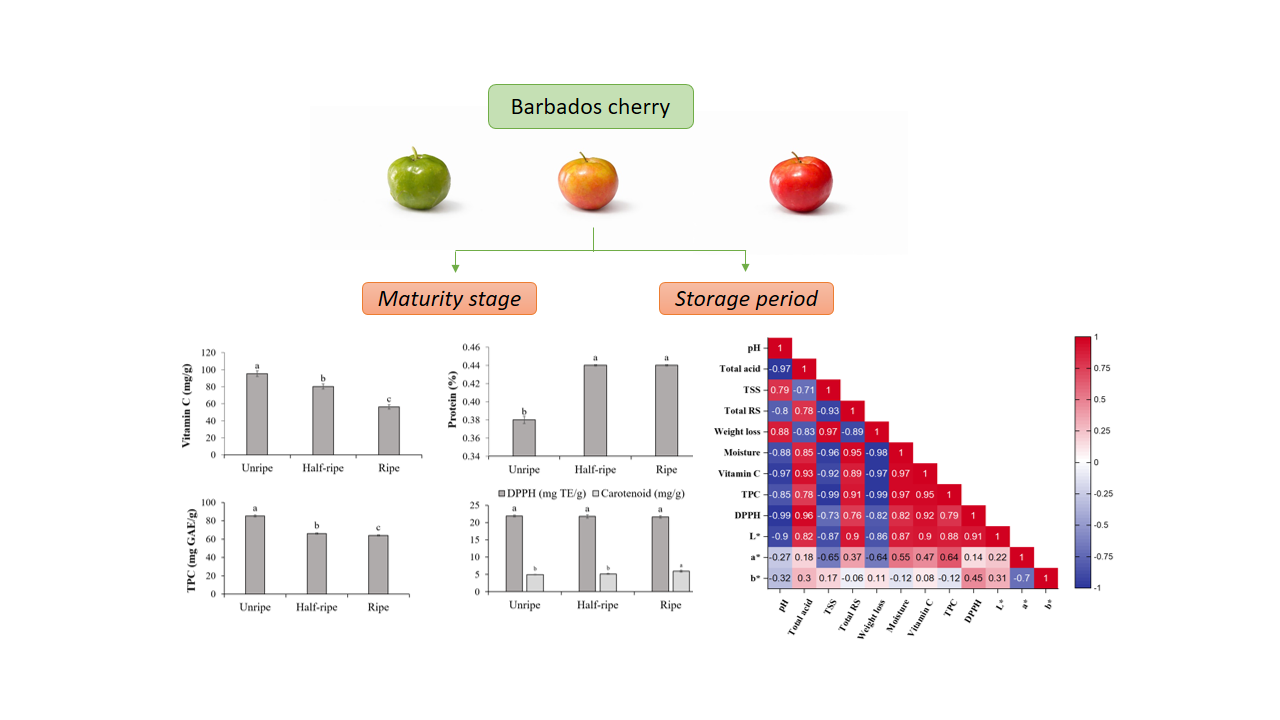
Barbados cherry (Malpighia emarginata D.C.) is notable for its rich vitamin C and phenolic content, both of which are significantly influenced by the fruit’s maturity stage and tend to decline during storage. This study evaluated the physicochemical and bioactive attributes of Barbados cherry at different maturity stages—unripe, half-ripe, and ripe—and during the preservation period to determine changes in fruit quality. The results indicated that the highest amounts of vitamin C (100 mg/g) and total phenolic content (TPC, 90 mg GAE/g) were found in unripe fruit, while half-ripe and ripe fruits exhibited higher protein, carotenoid, and sugar contents. During storage, half-ripe Barbados cherry stored at 12 ± 2 °C maintained superior physical and nutritional quality, retaining vitamin C (57.15 mg/g), TPC (51.46 mg GAE/g), and antioxidant activity (DPPH, 29.45 mg TE/g) after six days. Correlation analysis revealed strong positive relationships among vitamin C, TPC, and DPPH, suggesting coordinated degradation of antioxidant compounds during preservation. These findings emphasize that harvesting Barbados cherry at the half-ripe stage and storing it under moderate refrigeration effectively maintains both nutritional and sensory qualities, providing practical recommendations for postharvest handling and short-term commercialization.
How to Cite
T. T. Dang, T. ., & T. A. Tong, N. . (2026). Influence of maturity stage and storage duration on the physicochemical properties and eating quality of Barbados cherry (Malpighia emarginata D.C.) . Asia-Pacific Journal of Science and Technology, 31(02), APST–31. https://doi.org/10.22299/apst.2026.275335
References
Delva L, Schneider RG. Acerola (Malpighia emarginata DC): Production, postharvest handling, nutrition, and biological activity. Food Rev Int. 2013;29(2):107-126.
Mezadri T, Fernández-Pachón MS, Villano D, García-Parrilla MC, Troncoso AM. The acerola fruit: composition, productive characteristics, and economic importance. Arch Latinoam Nutr. 2006;56(2):101-109.
Prakash A, Baskaran R. Acerola, an untapped functional superfruit: a review on latest frontiers. J Food Sci Technol. 2018;55(9):3373-3384.
Moura CF, Oliveira LD, de Souza KO, da Franca LG, Ribeiro LB, de Souza PA, de Miranda MR. Acerola-Malpighia emarginata. In Exotic Fruits. Academic Press; 2018.
Chang SK, Alasalvar C, Shahidi F. Superfruits: Phytochemicals, antioxidant efficacies, and health effects–A comprehensive review. Crit Rev Food Sci Nutr. 2019;59(10):1580-1604.
Belwal T, Devkota HP, Hassan HA, Ahluwalia S, Ramadan MF, Mocan A, Atanasov AG. Phytopharmacology of Acerola (Malpighia spp.) and its potential as functional food. Trends Food Sci Technol. 2018;74:99-106.
Pommer CV, Barbosa W. The impact of breeding on fruit production in warm climates of Brazil. Rev Bras Frutic. 2009;31(2):612-634.
Braman K, Ahmad S, Siddiqui MW. Factors affecting the quality of fruits and vegetables. In Postharvest biology and technology of horticultural crops: principles and practices for quality maintenance. Academic Press; 2015.
Vendramini AL, Trugo LC. Chemical composition of acerola fruit (Malpighia punicifolia L.) at three stages of maturity. Food Chem. 2000;71(2):195-198.
Siddiqui MW, editor. Postharvest biology and technology of horticultural crops: principles and practices for quality maintenance. CRC Press; 2015.
Mohammed M. Acerola (Malpighia emarginata DC.). In Postharvest biology and technology of tropical and subtropical fruits. Woodhead Publishing; 2011.
Aghdam MS, Naderi R, Jannatizadeh A, Sarcheshmeh MA, Babalar M. Enhancement of postharvest chilling tolerance of anthurium cut flowers by γ-aminobutyric acid (GABA) treatments. Sci Hortic. 2016;198:52-60.
Crisosto CH, Gordon Mitchell F, Ju Z. Susceptibility to chilling injury of peach, nectarine, and plum cultivars grown in California. HortScience. 1999;34(6):1116-1118.
Maciel MI, Lima VL, Santos ES, Lima MD. Effects of biofilm and refrigeration on acerola postharvest conservation. Rev Bras Frutic. 2004;26(1):168-170.
Le TT, Luong HQ, Angeli DC, Le QT, Katleen R. Changes of total polyphenolics and vitamin C in acerola during storage and spray drying process. J Agric Dev. 2018;17(3):69-76.
Provesi JG, Dias CO, de Mello Castanho Amboni RD, Amante ER. Characterization and stability of quality indices on storage of pumpkin (Cucurbita moschata and Cucurbita maxima) purees. Int J Food Sci Technol. 2012;47(1):67-74.
Phuong NN, Le TT, Dang MQ, Van Camp J, Raes K. Selection of extraction conditions of phenolic compounds from rambutan (Nephelium lappaceum L.) peel. Food Bioprod Process. 2020;122:222-229.
Nguyen NM, Le TT, Vissenaekens H, Gonzales GB, Van Camp J, Smagghe G, Raes K. In vitro antioxidant activity and phenolic profiles of tropical fruit by‐products. Int J Food Sci Technol. 2019;54(4):1169-1178.
Rojas ML, Silveira I, Augusto PED. Ultrasound and ethanol pre-treatments to improve convective drying: Drying, rehydration, and carotenoid content of pumpkin. Food Bioprod Process. 2020;119:20-30.
Ozturk B, Celik SM, Karakaya M, Karakaya O, Islam A, Yarilgac T. Storage temperature affects phenolic content, antioxidant activity, and fruit quality parameters of cherry laurel (Prunus laurocerasus L.). J Food Process Preserv. 2017;41(1):e12774.
Jia C, Han F, Miao X, Yan A, Wu P, Sun Y. Study on the changes of sugar and acid in fermentation process of different varieties of cherry wine. J Food Sci Nutr. 2019;2(1):15-19.
Samim AK, Shivakumar BS, Ganapathi M. Effect of IBA, NAA and their combination on rooting and biochemical parameters of stem cuttings in Barbados cherry. Int J Res Appl Sci Biotechnol. 2021;8(5):147-150.
Düsman E, Berti AP, Mariucci RG, Lopes NB, Tonin LTD, Vicentini VEP. Radioprotective effect of the Barbados cherry (Malpighia glabra L.) against radiopharmaceutical iodine-131 in Wistar rats in vivo. BMC Complement Altern Med. 2014;14:41.
Gouthu S, Deluc LG. Timing of ripening initiation in grape berries and its relationship to seed content and pericarp auxin levels. BMC Plant Biol. 2015;15(1):1-14.
Righetto AM, Netto FM, Carraro F. Chemical composition and antioxidant activity of juices from mature and immature acerola (Malpighia emarginata DC). Food Sci Technol Int. 2005;11(4):315-321.
Kulkarni AP, Aradhya SM. Chemical changes and antioxidant activity in pomegranate arils during fruit development. Food Chem. 2005;93(2):319-324.
Lima VL, Mélo EA, Maciel MI, Prazeres FG, Musser RS, Lima DE. Total phenolic and carotenoid contents in acerola genotypes harvested at three ripening stages. Food Chem. 2005;90(4):565-568.
Andersson SC, Rumpunen K, Johansson E, Olsson ME. Carotenoid content and composition in rose hips (Rosa spp.) during ripening, determination of suitable maturity marker and implications for health-promoting food products. Food Chem. 2011;128(3):689-696.
Ribeiro BS, de Freitas ST. Maturity stage at harvest and storage temperature to maintain postharvest quality of acerola fruit. Sci Hortic. 2020;260:108901.
Davey MW, Montagu MV, Inze D, Sanmartin M, Kanellis A, Smirnoff N, Benzie IJ, Strain JJ, Favell D, Fletcher J. Plant L‐ascorbic acid: chemistry, function, metabolism, bioavailability and effects of processing. J Sci Food Agric. 2000;80(7):825-860.
Published: Mar 12, 2026
License

This work is licensed under a Creative Commons Attribution-NonCommercial-NoDerivatives 4.0 International License.