
Nattawoot Maleelai
Department of Physics, Faculty of Science, Khon Kaen University, Khon Kaen, Thailand
Wiwat Youngdee
Department of Physics, Faculty of Science, Khon Kaen University, Khon Kaen, Thailand
Nath Saowadee
Department of Physics, Faculty of Science, Khon Kaen University, Khon Kaen, Thailand
Keywords: Rice soaking Time-domain NMR NMR relaxation Glutinous rice Khao Dawk Mali 105 Chai Nat 1
Abstract
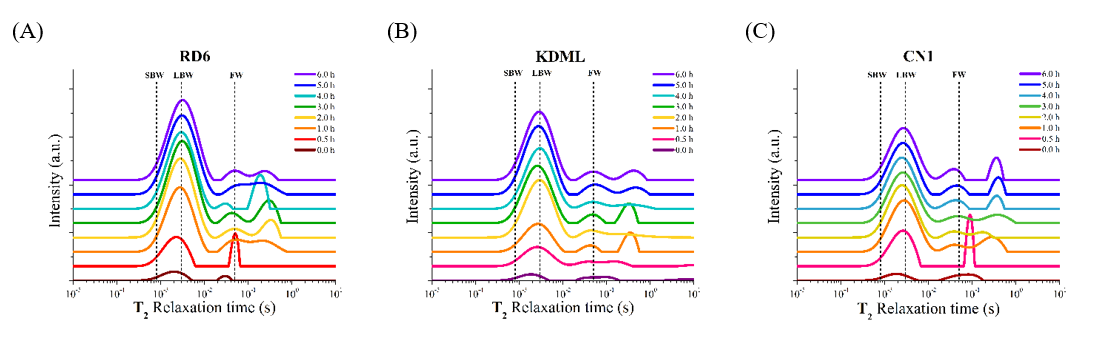
Glutinous rice requires a lo[nger soaking time than other rice cultivars. In this study, water transport in Thai glutinous rice RD6 was compared with that in the non-glutinous cultivars Khao Dawk Mali 105 (KDML) and Chai Nat 1 (CN1) using time-domain nuclear magnetic resonance. The amylose and amylopectin percentages of the three rice cultivars were measured to study their potential links to the water absorption of the rice, which was measured after soaking for 0, 0.5, 1, 2, 3, 4, 5, and 6 h. CN1 became saturated with water within 1 h, whereas RD6 and KDML became saturated after about 2 h. Glutinous rice RD6 absorbed the greatest amount of water, whereas CN1 absorbed the least. The amount of water absorbed was inversely related to the amylose percentage of the three cultivars. A smaller amount of amylose in the amylopectin structure may provide more space to absorb water. The rate of water absorption of RD6 and CN1 was considered to have been greatest in the first half hour of soaking, where their free-water peaks dominated the T2 spectra. Most of the absorbed water of the three rice cultivars was in the loosely bound state, corresponding to the water in the amorphous growth shells of granules. The physically bound water peak of RD6 gradually shifted to a higher T2 value with increasing soaking time, indicating that the molecular mobility of water increases with soaking time.
How to Cite
Maleelai, N. ., Youngdee, W. ., & Saowadee, N. . (2026). Water transport in Thai glutinous rice during soaking: investigation using 1H-NMR relaxation. Asia-Pacific Journal of Science and Technology, 31(02), APST–31. https://doi.org/10.22299/apst.2026.276814
References
Olsen KM, Purugganan MD. Molecular evidence on the origin and evolution of glutinous rice. Genetics. 2002 Oct 1;162(2):941–950.
Farooq A, Riaz MN, Iqbal A, Karim A, Javed M, Mubeen A, et al. Starches in Rice: Effects of Rice Variety and Processing. Foods. 2025;14(3):612.
Bao J. Structure, properties, and digestibility of cooked rice. In: Champagne ET, editor. Rice Chemistry and Technology. 4th ed. St. Paul (MN): AACC International; 2012. p. 269–296.
Fong-in S, Leethochavalit T, Surojanametakul V. Quality of cooked glutinous rice as affected by soaking time and steaming method. J. Food Res. 2025;9(1):392–401.
Gong M, Zhou Z, Jin J, Yu Y, Liu S, Han X, et al. Effects of soaking on physicochemical properties of four kinds of rice used in Huangjiu brewing. J Cereal Sci. 2020;91:102855.
Khan MdIH, Joardder MUH, Kumar C, Karim A. Multiphase porous media modelling: A novel approach to predicting food processing performance. Crit. Rev. Food Sci. Nutr. 2017;58(4):528–46.
Joardder MUH, Karim A. Development of a porosity prediction model based on shrinkage velocity and glass transition temperature. Dry. Technol. 2019;37(15):1988–2004.
Caurie M. Bound water: Its definition, estimation and characteristics. Int J Food Sci Technol. 2011;46(5):930–934.
Tang H, Godward J, Hills BP. The distribution of water in native starch granules—a multinuclear NMR study. Carbohydr Polym. 2000;43(4):375–87.
Gallant DJ, Bouchet B, Baldwin PM. Microscopy of starch: Evidence of a new level of granule organization. Carbohydr Polym. 1997 Mar 1;32(3–4):177–191.
Pérez S, Bertoft E. The molecular structures of starch components and their contribution to the architecture of starch granules: A comprehensive review. Starke. 2010;62(8):389–420.
Colnago LA, Wiesman Z, Pagès G, Musse M, Monaretto T, Windt CW, et al. Low field, time domain NMR in the agriculture and agrifood sectors: An overview of applications in plants, foods and biofuels. J Magn Reson. 2021;323:106899.
Mitchell J, Gladden LF, Chandrasekera TC, Fordham EJ. Low-field permanent magnets for industrial process and quality control. Prog Nucl Magn Reson Spectrosc. 2014;76:1–60.
Ateş EG, Domenici V, Florek-Wojciechowska M, Gradišek A, Kruk D, Maltar-Strmečki N, et al. Field-dependent NMR relaxometry for food science: Applications and perspectives. Trends Food Sci Technol. 2021;110:513–24.
Yubonmhat K, Chinwong S, Maleelai N, Saowadee N, Youngdee W. Cellular water and proton relaxation times of Thai rice kernels during grain development and storage. J Cereal Sci. 2019;88:65–70.
Zheng H, Du X, Guo L, Hu J, Xu Y, Zhao H. Using NMR to study changes in the characteristic constituents of stored rice. J Cereal Sci. 2017;75:179–185.
Srikaeo K, Rahman MS. Proton relaxation of waxy and non-waxy rice by low field nuclear magnetic resonance (LF-NMR) to their glassy and rubbery states. J Cereal Sci. 2018;82:94–98.
Besghini D, Mauri M, Simonutti R. Time domain NMR in polymer science: From the laboratory to the industry. Appl Sci (Basel). 2019;9(9):1801.
Kasai M, Lewis A, Marica F, Ayabe S, Hatae K, Fyfe CA. NMR imaging investigation of rice cooking. Food Res Int. 2005;38(4):403–410.
Tananuwong K, Reid DS. DSC and NMR relaxation studies of starch–water interactions during gelatinization. Carbohydr Polym. 2004;58(3):345–358.
Gomi Y, Takeuchi K, Fukuoka T. The rate of starch gelatinization as observed by PFG-NMR. J Cereal Sci. 1998;27(1):109–114.
Yubonmhat K, Youngdee W, Chinwong S, Saowadee N. A low-cost Arduino-based NMR console. J Phys Conf Ser. 2019;1380(1):012012.
Çelik H, Bouhrara M, Reiter DA, Fishbein KW, Spencer RG. Stabilization of the inverse Laplace transform of multiexponential decay through introduction of a second dimension. J Magn Reson. 2013;236:134–139.
Ohkubo T. Open Source 1D/2D Inverse Laplace Program. [cited 2023 Nov 10].
Butler JP, Reeds JA, Dawson SV. Estimating solutions of first kind integral equations with nonnegative constraints and optimal smoothing. SIAM J Numer Anal. 1981;18(3):381–397.
Wang L, Guo M, Zhang Y, Xue Y, Li S, Xu F, Chen J. Effects of soaking treatment on water distribution of rice grains, starch characteristics and eating quality of wet rice noodles. Int J Biol Macromol. 2024;224:134621.
Horigane AK, Suzuki K, Yoshida M. Moisture distribution of soaked rice grains observed by magnetic resonance imaging and physicochemical properties of cooked rice grains. J Cereal Sci. 2013;57(1):47–55.
Shi S, Zhang G, Zhao D, Ma J, Wang X, Chen D, Liu J, Wang J, Li L, Cao C, Jiang Y. Changes in water absorption and morphology of rice with different eating quality during soaking. Eur Food Res Technol. 2023;249:759–766.
Lian F, Zhang L, Chen Y, Wang J, Liu Q. Effects of starch gelatinisation and water migration on the microstructure of rice. Food Chem. 2024;437:137897.
Ding L, Ebrahimi S, Liu X, Persson S, Kirkensgaard JJK, Enemark-Rasmussen K, Chang J, Chen S, Blennow A, Czaja TP, Zhong Y. Characterizing maize starch gelatinization by low-field NMR spectroscopy. Carbohydr Polym. 2025;369:124292.
Zhu L, Cheng L, Zhang H, Wang L, Qian H, Qi X. Research on migration path and structuring role of water in rice grain during soaking. Food Hydrocoll. 2019;92:41–50.
Li M, Zhu K, Guo X, Peng W, Zhou H. Water status and starch–protein interactions during rice soaking and gelatinization: An LF-NMR study. Food Chem. 2022;380:132195.
Zhang Q, Shen H, Wang L. Low-field NMR analysis of water mobility and distribution in rice with different amylose contents during soaking. J Cereal Sci. 2023;107:104584.
Rachman A, Li X, Chen L. Characterization of water distribution and mobility during rice gelatinization using LF-NMR and DSC. LWT – Food Sci Technol. 2023;187:115472.
Xu Y, Bao J. Diffusion and water binding properties of rice starch systems analyzed by time-domain NMR. Carbohydr Polym. 2021;258:117686.
Published: Mar 12, 2026
License

This work is licensed under a Creative Commons Attribution-NonCommercial-NoDerivatives 4.0 International License.