
M. Rifqi Efendi
Department of Pharmacy, Faculty of Medicine and Health Sciences, Universitas Jambi, Jambi, 36122, Indonesia
Maimum
Department of Pharmacy, Faculty of Medicine and Health Sciences, Universitas Jambi, Jambi, 36122, Indonesia
Rion Nofrianda
Department of Psychology, Faculty of Medicine and Health Sciences, Universitas Jambi, Jambi, 36122, Indonesia
Elisma
Department of Pharmacy, Faculty of Medicine and Health Sciences, Universitas Jambi, Jambi, 36122, Indonesia
Raudatul Jannah
Department of Pharmacy, Faculty of Medicine and Health Sciences, Universitas Jambi, Jambi, 36122, Indonesia
Zahriana Putri
Department of Pharmacy, Faculty of Medicine and Health Sciences, Universitas Jambi, Jambi, 36122, Indonesia
Mesa S. Rusdi
Department of Pharmacy, Politeknik Kesehatan Kementerian Kesehatan Jambi, Jambi, 36128, Indonesia
Keywords: Mangifera indica L., Kombucha, Antioxidant, SPF, Wound healing
Abstract
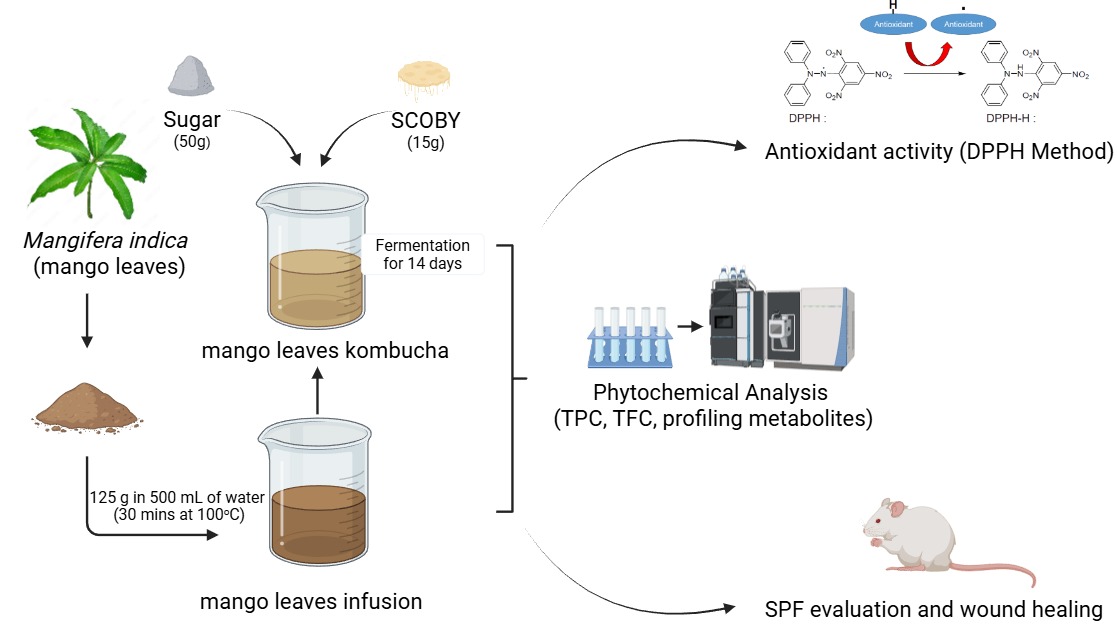
Traditionally produced from tea and sugar using a symbiotic culture of bacteria and yeast (SCOBY), Kombucha is a fermented beverage that has recently been expanded to include variety of plant-based substrates for cosmetic purposes. Mangiferin, tannins, and gallic acid derivatives, which have antioxidant, antidiabetic, anti-inflammatory, and antibacterial properties, are abundant in Mango (Mangifera indica L.) leaves, a byproduct of mango farming. This study investigated the antioxidant, UV-protective potentials, and wound-healing of mango leaf kombucha for cosmeceutical use. The study involved four main stages; mango leaf extraction, fermentation, product standardization, and pharmacological evaluation. Total phenolic and flavonoid contents were quantified, and bioactive constituents were identified using UPLC–MS. Total phenolic (29.1 ± 0.09 mg GAE/g) and flavonoid (9.14 ± 0.07 mg QE/g) contents were substantially higher in the fermented product than in the infusion (19.6 ± 0.33 mg GAE/g and 7.59 ± 0.03 mg QE/g, respectively). Nineteen bioactive compounds, including xanthones, flavonoids, and benzophenones, were detected. Mango leaf kombucha outperformed the infusion in terms of antioxidant activity (IC50 = 14 µg/mL vs. 24 µg/mL), UV protection (SPF 22.76 ± 0.68), and wound-healing efficacy (98.85% ± 1.34). These results demonstrate the potential of mango leaf kombucha as a natural component in cosmeceutical formulations aimed at photoprotection and skin restoration.
References
Gupta K, Bardhan P, Saikia D, Rather MA, Loying S, Mandal M, et al. Microbial Fermentation: Basic Fundamentals and Its Dynamic Prospect in Various Industrial Applications. In: Industrial Microbiology and Biotechnology. Verma Eds. Singapore: Springer, Singapore; 2022, p.107–128.
Jakubczyk K, Nowak A, Muzykiewicz-Szymańska A, Kucharski Ł, Szymczykowska K, Janda-Milczarek K. Kombucha as a Potential Active Ingredient in Cosmetics—An ex vivo Skin Permeation Study. Molecules. 2024;29(5):1018.
Zofia NŁ, Aleksandra Z, Tomasz B, Martyna ZD, Magdalena Z, Zofia HB, et al. Effect of Fermentation Time on Antioxidant and Anti-Ageing Properties of Green Coffee Kombucha Ferments. Molecules. 2020;25(22):5394.
Barakat N, Beaufort S, Rizk Z, Bouajila J, Taillandier P, El Rayess Y. Kombucha analogues around the world: A review. Crit Rev Food Sci Nutr. 2022;63(29):10105–29.
Kumar M, Saurabh V, Tomar M, Hasan M, Changan S, Sasi M, et al. Mango (Mangifera indica L.) Leaves: Nutritional Composition, Phytochemical Profile, and Health-Promoting Bioactivities. Antioxidants. 2021;10(2):1–23.
Efendi MR, Bakhtiar A, Rusdi MS, Putra DP. Simplified isolation method of mangiferin from Mangifera indica L. leaves and evaluation of tyrosinase inhibitory activity. Asia Pac J Sci Technol. 2023;28(06):6.
Phuong NTN, Ha MT, Nguyen DXT, Nguyen NY, Huynh HAT, Hau TP, et al. Development and antioxidant evaluation of mango leaf (Mangifera indica L.) extract loaded silk fibroin nanoparticles. Front Mater. 2024;11:1419697.
Espinosa-Espinosa L, Garduño-Siciliano L, Rodriguez-Canales M, Hernandez-Portilla LB, Canales-Martinez MM, Rodriguez-Monroy MA. The Wound-Healing Effect of Mango Peel Extract on Incision Wounds in a Murine Model. Molecules. 2022;27(1):259.
Li L, Chong L, Huang T, Ma Y, Li Y, Ding H. Natural products and extracts from plants as natural UV filters for sunscreens: A review. Animal Model Exp Med. 2022;6(3):183.
Tang X, Yang T, Yu D, Xiong H, Zhang S. Current insights and future perspectives of ultraviolet radiation (UV) exposure: Friends and foes to the skin and beyond the skin. Environ Int. 2024;185:108535.
Ministry of Health Indonesia. Indonesian Herbal Pharmacopeia. Second Edition. Directorate General of Pharmacy and Medical Devices. Jakarta: Directorate General of Pharmacy and Medical Devices, Indonesia; 2017.
Rusdi MS, Sofiyetti S, Efendi MR, Sani K F. Kombucha analog from Mahkota Dewa (Phaleria macrocarpa (Scheff) Boerl) fruit: Standardization of polyphenolic compounds, study of antioxidant and antihyperglycemic activities. J. Res. Pharm. 2025;29(6):2336-48.
Tang J, Dunshea FR, Suleria HAR. LC-ESI-QTOF/MS Characterization of Phenolic Compounds from Medicinal Plants (Hops and Juniper Berries) and Their Antioxidant Activity. Foods. 2020;9(1):7.
Mansur J, M.N.R. B, M.C.A. M. Determination of sun protection factor (SPF) by ultraviolet spectrophotometry. An Bras Dermatol. 1986; 61:121-124.
Lee SH. Evaluation of acute skin irritation and phototoxicity by aqueous and ethanol fractions of Angelica keiskei. Exp Ther Med. 2012;5(1):45.
Efendi MR, Gusti D, Syahrial AD, Rusdi MS. Evaluation of Coffee Mistletoe Leaf Ethanol Extract on Burn Healing Activity on White Male Rat. Journal of Pharmaceutical and Sciences. 2023;6(3):1059–67.
Antolak H, Piechota D, Kucharska A. Kombucha Tea-A Double Power of Bioactive Compounds from Tea and Symbiotic Culture of Bacteria and Yeasts (SCOBY). Antioxidants. 2021;10(10):1541.
Rao Y. Variation of the Content and Antioxidant Activity of Active Substances in the Kombucha Fermentation of Mulberry Leaves. Highlight Sci Eng Technol. 2024;91:396–401.
Kim H, Hur S, Lim J, Jin K, Yang TH,, Keehm IS, et al. Enhancement of the phenolic compounds and antioxidant activities of Kombucha prepared using specific bacterial and yeast. Food Biosci. 2023;56:103431.
Khaleil MM, Abd Ellatif S, Soliman MH, Abd Elrazik ES, Sh Fadel M. A bioprocess development study of polyphenol profile, antioxidant and antimicrobial activities of kombucha enriched with Psidium guajava L. J Microbiol Biotechnol Food Sci. 2020;9(6):1204–10.
Ma YL, Wang YZ, Feng Y, Duan DD, Yang HY, Wang J. Enhancing Probiotic, Sensory, and Antioxidant Properties of Polygonatum sibiricum Red. and Crataegus pinnatifida Bunge through Lactic Acid Fermentation for Functional Food Development. Int J Food Sci Technol. 2025;60(1): vvaf022.
Yu M, Gouvinhas I, Rocha J, Barros AIRNA. Phytochemical and antioxidant analysis of medicinal and food plants towards bioactive food and pharmaceutical resources. Scientific Reports. 2021;11(1):1–14.
Jyotshna, Khare P, Shanker K. Mangiferin: A review of sources and interventions for biological activities. Biofactors. 2016;42(5):504–14.
Du S, Liu H, Lei T, Xie X, Wang H, He X, et al. Mangiferin: An effective therapeutic agent against several disorders (Review). Mol Med Rep. 2018;18(6):4775–86.
Wang Z, Wu Z, Zuo G, Lim SS, Yan H. Defatted Seeds of Oenothera biennis as a Potential Functional Food Ingredient for Diabetes. Foods. 2021;10(3):538
Abdel-Mageed WM, Bayoumi SAH, Chen C, Vavricka CJ, Li L, Malik A, et al. Benzophenone C-glucosides and gallotannins from mango tree stem bark with broad-spectrum anti-viral activity. Bioorg Med Chem. 2014;22(7):2236–43.
Jhaumeer Laulloo S, Bhowon MG, Soyfoo S, Chua LS. Nutritional and Biological Evaluation of Leaves of Mangifera indica from Mauritius. J Chem. 2018;2018(1):6869294.
Berardini N, Fezer R, Conrad J, Beifuss U, Carle R, Schieber A. Screening of Mango (Mangifera indica L.) Cultivars for Their Contents of Flavonol O- and Xanthone C-Glycosides, Anthocyanins, and Pectin. J Agric Food Chem. 2005;53(5):1563–70.
Pan J, Yi X, Zhang S, Cheng J, Wang Y, Liu C, et al. Bioactive phenolics from mango leaves (Mangifera indica L.). Ind Crops Prod. 2018;111:400–6.
Tan L, Jin Z, Ge Y, Nadeem H, Cheng Z, Azeem F, et al. Comprehensive ESI-Q TRAP-MS/MS based characterization of metabolome of two mango (Mangifera indica L) cultivars from China. Sci Rep. 2020;10(1):20017.
Gabros S, Nessel TA, Zito PM. Sunscreens and Photoprotection. StatPearls. Treasure Island: StatPearls Publishing; 2023.
Kim HS, Song JH, Youn UJ, Hyun JW, Jeong WS, Lee MY, et al. Inhibition of UVB-induced wrinkle formation and MMP-9 expression by mangiferin isolated from Anemarrhena asphodeloides. Eur J Pharmacol. 2012;689(1–3):38–44.
Zofia NŁ, Aleksandra Z, Tomasz B, Martyna ZD, Magdalena Z, Zofia HB, et al. Effect of Fermentation Time on Antioxidant and Anti-Ageing Properties of Green Coffee Kombucha Ferments. Molecules. 2020;25(22):5394.
Herman A, Herman AP. Biological Activity of Fermented Plant Extracts for Potential Dermal Applications. Pharmaceutics. 2023;15(12):2775.
Ziemlewska A, Nizioł-Łukaszewska Z, Zagórska-Dziok M, Wójciak M, Szczepanek D, Sowa I. Assessment of Cosmetic and Dermatological Properties and Safety of Use of Model Skin Tonics with Kombucha-Fermented Red Berry Extracts. Int J Mol Sci. 2022;23(23):14675.
Amaro-Ortiz A, Yan B, D’Orazio JA. Ultraviolet Radiation, Aging and the Skin: Prevention of Damage by Topical cAMP Manipulation. Molecules. 2014;19(5):6202.
Hashim PW, Ferneini AM. Wound Healing. in Complications in Maxillofacial Cosmetic Surgery: Strategies for Prevention and Management. Springer Cham. 2018;37–45.
Rajaei S, Doudi M, Setorki M, Ahadi AM. Clinical and histopathological effects of ointment prepared from kombucha floating cellulose layer on wound healing and the activity of matrix metalloproteinase 1 in diabetic rats. Res. results pharmacol. 2022;8(3):9–18.
Kim TY, Lee BS, Jo BG, Heo SP, Jung YS, Kim SN, et al. Iridoid Glycosides and Coumarin Glycoside Derivatives from the Roots of Nymphoides peltata and Their in vitro Wound Healing Properties. Int J Mol Sci. 2024;25(2): 1268
Yang DJ, Moh SH, Son DH, You S, Kinyua AW, Ko CM, et al. Gallic Acid Promotes Wound Healing in Normal and Hyperglucidic Conditions. Molecules. 2016;21(7): 899.
License

This work is licensed under a Creative Commons Attribution-NonCommercial-NoDerivatives 4.0 International License.